As a personal prayer and study discipline, I read and reflect on the scripture reading of the day using a process of reflective Bible study called "Gospel Based Discipleship" or "African Bible Study."

"Gospel Based Discipleship" is a way of engaging the scripture by reading the text 3 times (usually in a different translation) and asking the following questions after each time it is read. Even though it's called "Gospel Based Discipleship," it doesn't mean that all the readings are from one of the Gospels. It's just a method of scripture reflection.

1. What one word, phrase, or idea stands out to you?
2. What is Jesus (or the reading) saying to you?
3. What is Jesus (or the reading) calling you to do?

I hope that this blog will enhance your own spiritual discipline as you read, mark, learn, and inwardly digest God's Holy Word.

Showing posts with label Challenge. Show all posts

Friday, April 6, 2012

John 13:36-38 (NRSV)

Simon Peter said to him, "Lord, where are you going?" Jesus answered, "Where I am going, you cannot follow me now; but you will follow afterward."  Peter said to him, "Lord, why can I not follow you now?   I will lay down my life for you."  Jesus answered, "Will you lay down your life for me?  Very truly, I tell you, before the cock crows, you will have denied me three times.
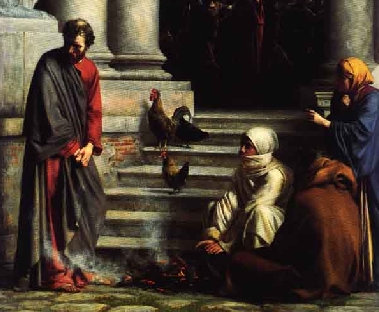

“I will lay down my life for you,” says Simon Peter.  Peter is an honest and good disciple.  He is genuine in his promise to stand by Jesus through thick and thin.  However, Jesus knows that even Peter will waiver when faced with extreme adversity.

Today is Good Friday, and our Gospel lesson from John is short.  Our focus today is on the cross and the crucifixion of our Lord.  In that context, this Gospel reading means to me that even the most devout will be challenged.  Jesus tells Peter that even though he will not be able to follow now, he will follow afterward.  Peter promises to stand by Jesus and lay down his life.  However, we know that Peter denied Jesus as Jesus predicted.  Peter denies Jesus three times.

The call that I hear today is not worry, but stand firm as we can in our path as we follow Christ.  God understands how tough it is.  Peter was bold in his faith, and was a straight shooter, always proclaiming Christ, spreading the Good News of God’s salvation.  However, when faced with adversity, Peter buckles under the pressure and denies Jesus.  What makes us think that we could do any better than Peter?  We could only hope that we would have an ounce of the faith that Peter had, and be willing to proclaim Christ when we are faced with challenge.

Friday, February 17, 2012

John 10:31-42 (NRSV)

The Jews took up stones again to stone him.  Jesus replied, "I have shown you many good works from the Father. For which of these are you going to stone me?"  The Jews answered, "It is not for a good work that we are going to stone you, but for blasphemy, because you, though only a human being, are making yourself God."  Jesus answered, "Is it not written in your law, 'I said, you are gods'?  If those to whom the word of God came were called 'gods'-and the scripture cannot be annulled-  can you say that the one whom the Father has sanctified and sent into the world is blaspheming because I said, 'I am God's Son'?  If I am not doing the works of my Father, then do not believe me.  But if I do them, even though you do not believe me, believe the works, so that you may know and understand that the Father is in me and I am in the Father."  Then they tried to arrest him again, but he escaped from their hands.

He went away again across the Jordan to the place where John had been baptizing earlier, and he remained there.  Many came to him, and they were saying, "John performed no sign, but everything that John said about this man was true."  And many believed in him there.


Blasphemy…  So, the “Jews” claim that Jesus is guilty of blasphemy.  He isn’t guilty for the works he has performed, but they say he is guilty of irreverence or impiety to God.  They thought Jesus was making himself God.  Little did they know what they were up against.  Nevertheless, they once again reach for the stones.

Jesus lets the works testify to who he is, and that he does them only by the power that has been bestowed upon him by God.  He is the one that God has made holy and sent into the world, yet he is not believed by the religious powers.  Jesus reminds them of the prophets (the ones to whom the word of God came), and how the prophets were treated.

Escaping arrest, Jesus slips away across the Jordan river, to where his ministry began – where he was baptized.  People still came to him, testifying to the signs, and believing everything that John said about him.

The Pharisees and scribes (the Jews) who challenge Jesus continue to feel the pressure of their own creation.  Jesus is upsetting the apple cart, and making life difficult for them.  However, Jesus has done nothing wrong but continues to be blamed with trumped up charges and false accusations.

The call I hear today is be who you are.  Jesus is just being who he is – God.  We are not God and shouldn’t try to be God.  I feel that the leaders are challenged because they think that they have the only path to God, and therefore get to control who comes to God and how.  Jesus provides the true way to God, through belief in him.  Only if we are true to who we are can show others the way to God.

We are working hard at putting together our Lenten series at Trinity called “Outward Signs.”  In this series, small groups will discuss what it means to be an visible sign of Christ in the world.  This takes the church gathering beyond the 4 walls, and puts it in the context of the world.

Tuesday, February 7, 2012

John 8:1-11 (NRSV)

… Jesus went to the Mount of Olives.  Early in the morning he came again to the temple. All the people came to him and he sat down and began to teach them.  The scribes and the Pharisees brought a woman who had been caught in adultery; and making her stand before all of them, they said to him, "Teacher, this woman was caught in the very act of committing adultery.  Now in the law Moses commanded us to stone such women.  Now what do you say?"  They said this to test him, so that they might have some charge to bring against him. Jesus bent down and wrote with his finger on the ground.  When they kept on questioning him, he straightened up and said to them, "Let anyone among you who is without sin be the first to throw a stone at her."  And once again he bent down and wrote on the ground.  When they heard it, they went away, one by one, beginning with the elders; and Jesus was left alone with the woman standing before him.  Jesus straightened up and said to her, "Woman, where are they?  Has no one condemned you?"  She said, "No one, sir."  And Jesus said, "Neither do I condemn you. Go your way, and from now on do not sin again."
“He bent down and wrote on the ground.”  I realize that we are all in different places.  Our thinking and reading these reflections are through the different lenses of our own experience.  I think that the sentence about him writing on the ground jumps out because, to me, it doesn’t otherwise belong.  Why did he write on the ground?  Why is it important to mention?

I would like to make the suggestion that Jesus gives us the image of a challenge, as if he were drawing a line in the sand saying, “Let anyone among you who wants to stone her come cross this line – and then you will deal with me!”  We can almost see the Jesus meek and mild puff out his chest for a minute and get tough in order to protect the woman.  It must have worked, because everyone dispursed and none were left but her and Jesus.

At the beginning of the passage, I want to yell out, “It’s a trap, Jesus…  don’t answer them!”  When the woman is brought to him, it's one of their schemes that they use in order to trap Jesus.  It's a catch-22.  He is doomed either way.  The Pharisees are keeping the letter of the law rather than the intent of the law.  They want to trick Jesus into going against what is prescribed in the law of Moses, but Jesus uses this opportunity to teach them in a very simple way that the complete law is intended for all – and that all fall short of keeping the law.  It obviously works, because they all leave.  Instead of condemning another, they turned the condemnation inward and started to think of their own sin.

We, like the Pharisees are quick to condemn and judge the way others act, rather than first look at ourselves.  I think that our call today is to be introspective of our outward actions.  Examine ourselves, prior to accusing another.  Without condemnation, but with forgiveness and guidance, Jesus offers the accused woman another chance.  Are we quick to condemn, and want to immediately pick up the stone and right the world, or do we come from a place of forgiveness – having first forgiven ourselves and then extending that forgiveness to others – and offering guidance rather than condemnation?

Saturday, February 4, 2012

John 7:14-36 (NRSV)

About the middle of the festival Jesus went up into the temple and began to teach. The Jews were astonished at it, saying, ‘How does this man have such learning, when he has never been taught?’  Then Jesus answered them, ‘My teaching is not mine but his who sent me.  Anyone who resolves to do the will of God will know whether the teaching is from God or whether I am speaking on my own.  Those who speak on their own seek their own glory; but the one who seeks the glory of him who sent him is true, and there is nothing false in him.

‘Did not Moses give you the law? Yet none of you keeps the law. Why are you looking for an opportunity to kill me?’ The crowd answered, ‘You have a demon! Who is trying to kill you?’ Jesus answered them, ‘I performed one work, and all of you are astonished. Moses gave you circumcision (it is, of course, not from Moses, but from the patriarchs), and you circumcise a man on the sabbath. If a man receives circumcision on the sabbath in order that the law of Moses may not be broken, are you angry with me because I healed a man’s whole body on the sabbath? Do not judge by appearances, but judge with right judgement.’

Now some of the people of Jerusalem were saying, ‘Is not this the man whom they are trying to kill? And here he is, speaking openly, but they say nothing to him! Can it be that the authorities really know that this is the Messiah? Yet we know where this man is from; but when the Messiah comes, no one will know where he is from.’  Then Jesus cried out as he was teaching in the temple, ‘You know me, and you know where I am from. I have not come on my own. But the one who sent me is true, and you do not know him.  I know him, because I am from him, and he sent me.’  Then they tried to arrest him, but no one laid hands on him, because his hour had not yet come.  Yet many in the crowd believed in him and were saying, ‘When the Messiah comes, will he do more signs than this man has done?’

The Pharisees heard the crowd muttering such things about him, and the chief priests and Pharisees sent temple police to arrest him.  Jesus then said, ‘I will be with you a little while longer, and then I am going to him who sent me.  You will search for me, but you will not find me; and where I am, you cannot come.’  The Jews said to one another, ‘Where does this man intend to go that we will not find him? Does he intend to go to the Dispersion among the Greeks and teach the Greeks?  What does he mean by saying, “You will search for me and you will not find me” and, “Where I am, you cannot come”?’


Frustration! I hear frustration in Jesus’ voice, in his teaching, and in his message. It's easy to get frustrated when you feel that your message is falling on deaf ears. This passage is a continuation from yesterday’s “undercover Jesus” trying to get a new prospective on things and assess the situation by being in disguise at the festival. It is possibly his frustration with the situation that pushes him to the point of getting up and teaching in the middle of the festival.

In his teaching, Jesus has very challenging words for the folks that are critical of his message. He points out that others have been quick to jump to conclusions about who he is and what he has come to do.  Some people gathered at the festival think that Jesus may be the messiah, and they are trying to figure out who he is.  The Pharisees and scribes feel challenged.  The status-quo is being upset by Jesus' prophetic teaching, and they are getting nervous, needing to put an end to Jesus’ popularity and make a spectacle of him.  They need to squelch his influence before he gets too politically powerful and becomes able to overthrow them. The scripture says that they tried to arrest him, but it wasn’t Jesus’ time.

My first thought is how often we get twisted into thinking something about someone else based on another’s testimony.  The leaders want the people to think that Jesus’ teaching is bad because it is against what they are teaching.  They want others to think that Jesus is a threat to their well being, so they create trumped up accusations of blasphemy and heresy.  In this context, I feel that we are called to make up our own mind.  We need to decide for ourselves who this prophetic teacher, Jesus really is.  He is revealed to us as very human and gets as aggravated and frustrated as we do (especially when people don’t listen to us) - yet his teaching is unlike any that has ever been before him or any that has come since.